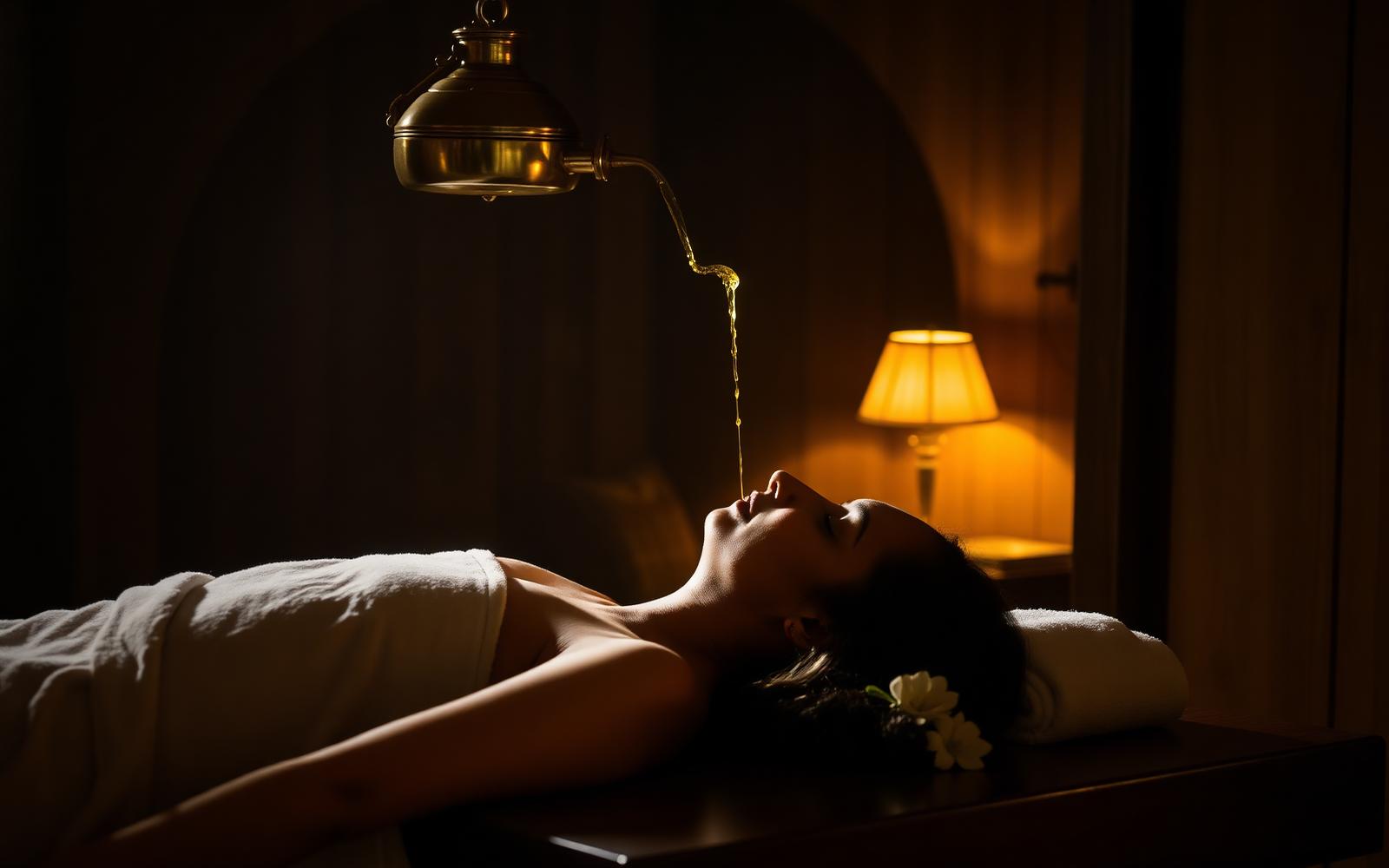
There is a moment, usually around the eighth or ninth minute, when the body stops waiting for something to happen. The warmth on the forehead has become continuous rather than new. Breathing slows without being asked to. The internal commentary that narrates most of our waking hours loses its thread. This is not sleep, and it is not quite wakefulness either. In the classical texts it is described simply as a state where the mind rests in itself.
Shirodhara is among the most recognisable therapies in Kerala Ayurveda, and also one of the most misunderstood. It appears on spa menus around the world as an hour of pleasant oil pouring. In its traditional context, it is a precisely prescribed clinical procedure — the liquid, its temperature, the height of the vessel, the rhythm of the stream and the number of days are all decided for a specific person with a specific imbalance.
Watch this short explanation.
What is Shirodhara?
The name comes from two Sanskrit words: shiro, meaning head, and dhara, meaning a continuous stream or flow. Shirodhara is the practice of pouring a warm liquid in a steady, unbroken stream over the forehead — specifically over the region between the eyebrows and the hairline — from a vessel suspended a fixed distance above the body, while the person lies still on a wooden treatment table.
It belongs to a wider family of therapies known collectively as Murdhni Taila, the therapeutic application of oils to the head. Within that family, Shirodhara occupies a particular place: where other procedures work through pressure, retention or massage, Shirodhara works almost entirely through rhythm and warmth. There is no manipulation of tissue. What acts on the nervous system is repetition — the same sensation, at the same place, at the same tempo, for long enough that the body stops guarding.
Traditionally, Shirodhara is not offered as a standalone treatment. It is one element within a broader plan that may include internal medicines, dietary correction, oleation, and often a full Panchakarma sequence. Understanding where it sits in that sequence is the difference between a relaxing hour and genuine therapeutic effect.
Why Kerala became the home of Shirodhara
Kerala's relationship with Ayurveda is unusual. Elsewhere in India, Ayurveda survived largely as a tradition of internal medicine and manuscripts. In Kerala it survived as a living practice of hands — of therapies performed daily, taught by demonstration rather than description, and passed within families for generations. The great Kerala contribution to Ayurveda is precisely this body of external therapies: Pizhichil, Navarakizhi, Elakizhi, Sirovasti and Shirodhara.
There are practical reasons. The climate is humid and warm for most of the year, which suits oil-based procedures — the skin stays receptive and the body does not have to fight cold. The state grows an extraordinary density of medicinal plants, so the oils used in these therapies could be made locally, freshly and in quantity. And the region's monsoon gave the calendar something rare: a season when the air is cool and damp, the pores are open, and the body is unusually willing to release what it has been holding.
The result is that the technique of Shirodhara — the height of the pot, the diameter of the stream, the way the vessel is moved gently side to side, the exact preparation of the oil — exists in Kerala as craft knowledge rather than as textbook instruction. It is why the same therapy performed in two places can feel entirely different.
The procedure, step by step
A traditional Shirodhara session is quiet and unhurried, and follows a sequence that has changed very little in centuries.
Before the session
The therapy is always preceded by a physician's assessment. Pulse, digestion, sleep pattern, bowel habit, menstrual history where relevant, current medication and the nature of the complaint are all considered before the liquid is chosen. Shirodhara performed with the wrong medium, or at the wrong stage of treatment, can leave a person feeling heavy, congested or dull rather than clear.
Most sessions begin with a short, gentle oil application to the head, neck and shoulders. This settles the muscles that hold the head, and warms the tissue so that the stream that follows is received rather than resisted.
During the session
- ◆You lie on your back on a wooden treatment table, head slightly tilted, eyes covered with a soft cloth or a cotton pad and the ears protected.
- ◆A vessel — traditionally brass, with a wick or aperture at its base — is suspended roughly four finger-widths above the forehead.
- ◆The liquid, warmed to body temperature, begins to fall as a thin, continuous thread onto the centre of the forehead.
- ◆The therapist moves the vessel slowly and rhythmically from side to side across the forehead, and returns the collected liquid to the vessel so that the temperature and flow stay constant.
- ◆The stream continues without interruption for around thirty to forty-five minutes, depending on the prescription.
- ◆The session ends with the head being wiped, the scalp gently pressed, and the person allowed to rest.
After the session
Rest is part of the treatment, not an optional extra. Guests are asked to avoid cold water, wind, screens and travel for the remainder of the day, and to eat lightly. Warm water, warm food and quiet are the whole of the aftercare. Most people sleep unusually deeply that night — often the first thing they report the following morning.
The stream must never break. It is not the oil that heals the mind, but the unbroken rhythm of it.
The four kinds of Shirodhara
Shirodhara is named for the liquid used, and the choice of liquid is the most important clinical decision in the therapy. Four variants are described in classical practice.
Taila Dhara — medicated oil
The most commonly used form, and the one most people mean when they say Shirodhara. Medicated sesame oil, often prepared with herbs such as bala, ashwagandha, brahmi or chandana, is used where dryness, depletion, anxiety, insomnia and restlessness dominate — the classical picture of aggravated Vata. Oil is warming, grounding and nourishing, and it is the medium of choice when the nervous system is over-firing rather than sluggish.
Takra Dhara — medicated buttermilk
Thin buttermilk medicated with herbs such as amalaki or musta is used where there is heat, burning sensation, irritability, chronic headache, premature greying or certain scalp conditions. Takra is cooling and light, and it is often chosen for people who find oil oppressive or who run hot.
Ksheera Dhara — medicated milk
Milk processed with cooling and soothing herbs is used where there is significant heat combined with depletion — burning eyes, tension headaches with a hot quality, sleeplessness after a long period of overwork.
Kwatha and Jala Dhara — decoctions and water
Herbal decoctions are used in more specific conditions, and are typically prescribed for shorter durations. These forms are less common and are almost always part of a larger treatment plan rather than a therapy on their own.
Benefits of Shirodhara
It is worth being careful here, because Shirodhara is often described in language it cannot support. What follows is what the therapy is traditionally used for, and what people consistently report, described plainly.
Stress that has become physical
The most consistent effect of Shirodhara is a reduction in the physical residue of stress — the clenched jaw, the shoulders that will not drop, the shallow breathing, the sense of being permanently mid-task. Ayurveda understands this as disturbed Vata in the head and nervous system, and treats it with warmth, rhythm and oleation rather than with stimulation. This is why the therapy is central to almost every stress programme in Kerala.
Sleep that has stopped being restorative
Difficulty falling asleep, waking between two and four in the morning, or sleeping a full night and waking unrefreshed are among the most common reasons people are prescribed Shirodhara. The therapy does not sedate. It appears to help the body relearn the transition into rest, which is often the part that has broken.
Tension headaches and migraine patterns
Where headaches are driven by tension, poor sleep, screen strain or irregular routine, Shirodhara is frequently included in the plan — usually alongside internal medicines and dietary correction, and often with Nasya, a nasal therapy that addresses the same region by another route.
Mental fatigue and difficulty concentrating
Many guests arrive describing not illness but flatness: a mind that will not settle onto a task, memory that has become slippery, a persistent low-grade tiredness. Shirodhara is traditionally used in this territory, and is one reason the therapy features in Rasayana or rejuvenation programmes.
Scalp, hair and eye complaints
Because the therapy nourishes the scalp directly, it is also used for dryness, certain kinds of hair fall, premature greying and the strained, burning eyes that come from long hours of close work.
What Shirodhara is not is a cure for a psychiatric condition, a substitute for prescribed medication, or a single-session solution. Its effects are cumulative, which is why it is prescribed as a course — commonly seven, fourteen or twenty-one consecutive days.
Who Shirodhara suits, and who should wait
The therapy is gentle, but gentleness is not the same as universal suitability. A physician will generally consider Shirodhara appropriate for adults with stress-related complaints, sleep disturbance, tension headaches, mental fatigue and certain neurological and scalp conditions, and as part of rejuvenation after a period of depletion.
It is usually deferred or modified in the presence of acute fever or infection, recent head or neck injury, acute sinus congestion, certain skin conditions of the scalp, during the early days of a heavy cold, in the first trimester of pregnancy, and where there is uncontrolled blood pressure or an unstable cardiac condition. Anyone taking regular medication should have it reviewed as part of the assessment. None of this is a checklist to self-apply — it is the reason the assessment exists.
How long a course of Shirodhara should be
A single session is pleasant and often surprisingly deep, but it is not treatment. Traditional practice prescribes Shirodhara in courses, most commonly for seven, fourteen or twenty-one days, performed at the same time each day.
- ◆Seven days — suitable for acute stress, jet lag, short sleep disturbance or as part of a short reset stay.
- ◆Fourteen days — the most common prescription for chronic stress, established insomnia and recurring tension headaches.
- ◆Twenty-one to twenty-eight days — used where the complaint is long-standing, or where Shirodhara forms part of a full Panchakarma or Rasayana programme.
This is also why residential treatment matters. The therapy asks for a day with nothing after it: no commute, no meeting, no screen. Undertaken between two working days, most of its effect is spent immediately.
Where Shirodhara sits within Panchakarma
Panchakarma is a staged process: preparation, the principal procedures, and a carefully managed return to ordinary life. Shirodhara is most often used in the preparatory and the concluding phases — during preparation it settles the nervous system so that the deeper procedures are tolerated calmly, and afterwards it supports the sleep and mental clarity that the body is rebuilding.
If you are reading about Shirodhara because you are considering a longer treatment, it is worth understanding that wider structure first. Our guide to Panchakarma treatment in Kerala sets out how the phases work, how long each takes and what a residential programme actually involves day by day.
What a session feels like
The first few minutes can feel strange. There is a natural reflex to track the movement of the stream, to anticipate where it will land next. Then the pattern becomes predictable, the tracking stops, and something in the body lets go of a job it did not know it was doing.
People describe the middle of the session differently — floating, drifting, a kind of alert stillness. Some fall asleep. Some find that unrelated memories surface with unusual clarity. A few find the first two or three sessions emotionally unsettling, which is well recognised in traditional practice and usually passes; it is one more reason the therapy is supervised rather than simply booked.
The clearest sign that a course is working is rarely dramatic. It is a slightly earlier bedtime. A morning that begins without dread. A day in which the shoulders stay where they belong.
Choosing where to have Shirodhara in Kerala
Because the therapy is popular, it is widely offered — and the range in quality is wide. A few questions separate clinical practice from spa treatment.
- ◆Is the therapy prescribed by a registered Ayurveda physician after an individual assessment, or chosen from a menu?
- ◆Which liquid will be used, and why that one for you? A practitioner should be able to answer this in a sentence.
- ◆Are the oils prepared traditionally, and is the same oil reused between guests?
- ◆Is the therapist trained in this specific procedure, and is the stream genuinely continuous for the full duration?
- ◆Is the treatment part of a plan that includes diet, routine and internal medicine, or is it offered in isolation?
- ◆Is there somewhere quiet to rest afterwards, and is rest actually built into the day?
The last point is the one most often overlooked. A perfectly performed Shirodhara followed by an afternoon of traffic and phone calls is a wasted therapy.
A closing thought
What makes Shirodhara remarkable is how little it asks. No effort, no technique to learn, no discipline to sustain. You lie still, and warmth arrives at a steady rhythm, and after some minutes the mind stops running ahead of itself.
That is not magic. It is what happens when a nervous system that has been braced for months is finally given a reason, repeated often enough to be believed, to stop bracing.