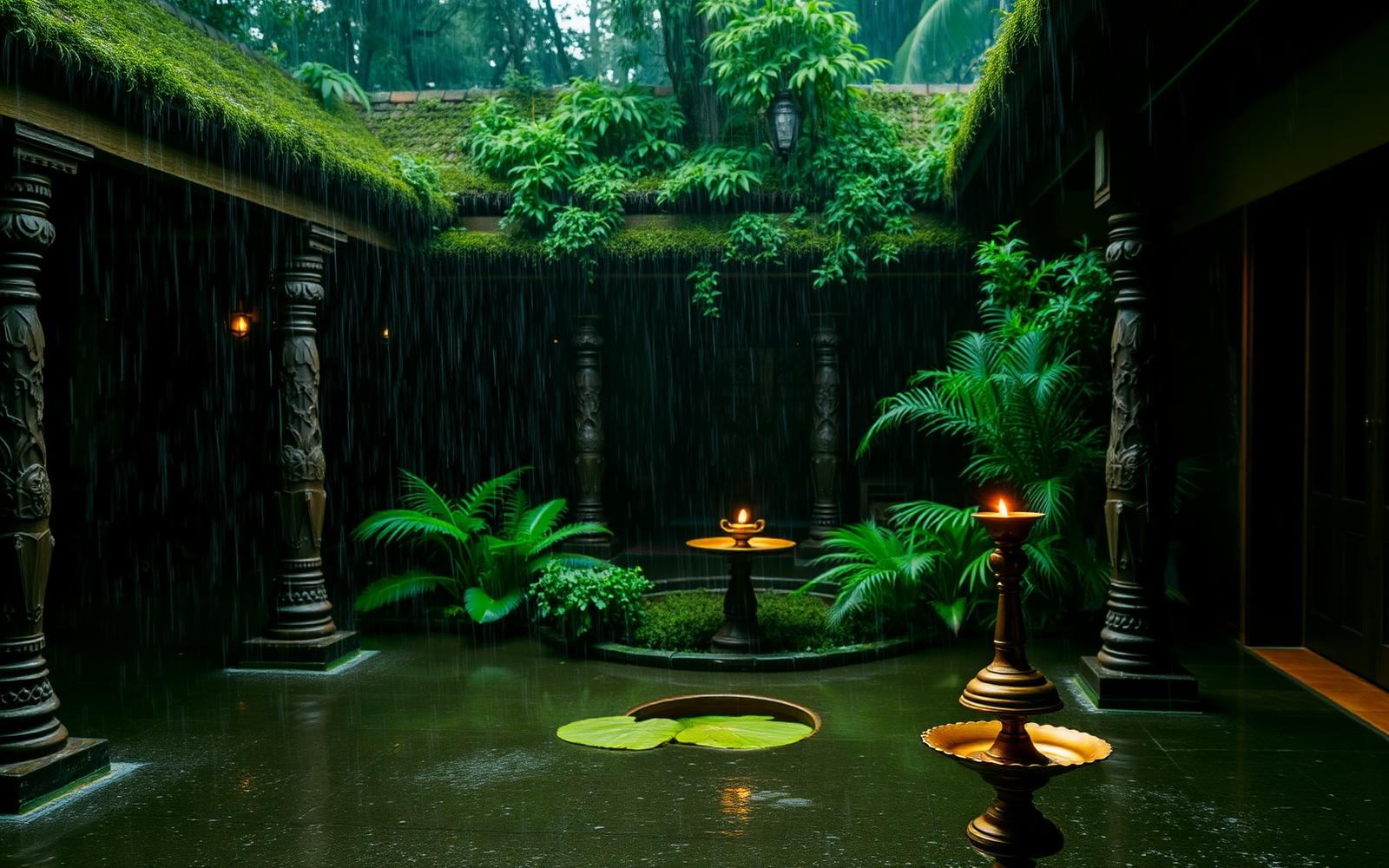
The rain in Kerala during Karkidakam is not weather in the way most people experience weather. It is a condition — continuous, heavy, unhurried, lasting for days. The light goes soft and green. The air cools and thickens. Sound is absorbed. Roads empty. Everything slows down, including the people.
And for centuries, this is precisely when Kerala families chose to take medicine. Not because they were ill in July, but because the tradition holds that this is when the body is most willing to be treated — and, just as importantly, most in need of it.
Watch this short explanation.
What is Karkidakam?
Karkidakam is the final month of the Malayalam calendar, falling roughly between mid-July and mid-August. It sits at the heart of the south-west monsoon, when rainfall in Kerala is at its heaviest and most sustained.
In the agricultural past it was known as Panja Masam, the month of scarcity: the harvest was finished, the new crop was not yet in, work in the fields was impossible, and stored food was thin. Bodies were depleted, illness was common, and the season had a reputation for weakness. Rather than simply endure it, Kerala built a therapeutic regimen around it.
That regimen is called Karkidaka Chikitsa — monsoon treatment. It combines specific foods, medicated gruels, herbal preparations, oil therapies, adjusted routine and, for many families, a formal course of Panchakarma. It is undertaken by the healthy as much as by the unwell, which makes it one of the clearest surviving examples of preventive medicine practised at the scale of a whole society.
Why the body responds differently in the monsoon
The reasoning behind the season is specific, and it works on several levels at once.
Digestion is naturally weaker
Ayurveda observes that agni — the digestive and metabolic fire — is at its lowest during the monsoon. This is why heavy, cold and raw foods sit badly in the rains, and why the traditional monsoon diet turns towards warm, light, well-cooked and lightly spiced food. Weak digestion is also the reason accumulated imbalance becomes symptomatic in this season: old aches return, skin flares, digestion becomes unreliable, energy drops.
A tradition that treats disease as accumulation reads this as an opportunity rather than a misfortune. What becomes symptomatic becomes accessible.
Vata is aggravated, and Vata responds to oil
The monsoon aggravates Vata — the principle governing movement, dryness, cold and the nervous system. This is felt as stiff joints, unsettled sleep, anxiety, cracking knees, cold extremities and a general restlessness. Kerala's therapeutic repertoire is unusually rich in exactly the treatments that settle Vata: warm oil, steady rhythm, oleation, warmth applied for long periods. The season and the medicine are matched.
The skin and channels are open
This is the most practical reason of all, and the one therapists mention first. In the cool, humid monsoon air the pores are open, the skin is soft and receptive, and the body is not dehydrated by heat. Oils are absorbed more readily, and external therapies — Abhyanga, Pizhichil, the various Kizhi treatments, Shirodhara — penetrate more effectively than they do in the dry heat of March or April.
The environment cooperates
Panchakarma asks for rest, warmth, quiet and protection from wind, sun and dust. Kerala in Karkidakam supplies all of it without effort. The air is cool but not cold, the dust is gone, the days are dim and slow, and there is genuinely nothing else to do. Recovery is easier when the world outside is not competing for your attention.
Fresh medicine
The monsoon is also when medicinal plants are at their most abundant, and traditionally when many preparations were made. Freshly gathered herbs, freshly prepared oils and gruels are part of what the season made possible.
In the rains the pores are open, the mind is quiet and there is nowhere to be. The season does half the work of the treatment.
What Karkidaka Chikitsa involves
The monsoon regimen has both a domestic form, practised in Kerala households, and a clinical form undertaken in Ayurveda hospitals. They share the same logic.
Karkidaka Kanji — the medicated gruel
The best-known element. A gruel of rice cooked with a compound of herbs and spices — often including fenugreek, cumin, ajwain, dried ginger, coconut milk and a mixture of medicinal seeds and roots — taken once daily, usually for a week or longer during the month.
Its purpose is straightforward: to support weak digestion, restore warmth, and provide light nourishment that the body can actually absorb. In many Kerala households the kanji is still made at home, and the recipe is a family matter.
Dietary discipline
The monsoon diet is warm, light, freshly cooked and lightly spiced. Curd, cold drinks, raw salads, heavy meats, fried food, leftover food and day-old preparations are all traditionally avoided. Warm water — often boiled with dried ginger or cumin — replaces cold drinking water. Meals are earlier and lighter, particularly in the evening.
Oil therapies and Panchakarma
For those undertaking formal treatment, the monsoon is the season for oleation and the classical Kerala therapies. Abhyanga and medicated steam, Pizhichil, Navarakizhi, Elakizhi, Shirodhara, Kativasti, Nasya and the Panchakarma procedures themselves are all commonly prescribed in this period.
Internal preparations
Medicated ghee, decoctions and Rasayana preparations are prescribed according to the individual. Many Kerala families take a rejuvenative preparation through the month as a matter of routine rather than in response to any complaint.
Routine, rest and quiet
Early nights, no daytime sleeping in most prescriptions, avoidance of damp clothing and exposure to cold wind, reduced physical exertion, and time set aside for stillness. In the traditional calendar the month was also devoted to reading and prayer — a form of Achara Rasayana, the therapeutic value of conduct and routine.
Who benefits most from monsoon treatment
The season is well suited to almost anyone, but a few situations respond particularly well.
- ◆Joint and spine complaints — chronic back and neck pain, osteoarthritis, stiffness and inflammatory joint conditions, which the monsoon typically aggravates and monsoon therapy typically addresses.
- ◆Vata-dominant conditions — insomnia, anxiety, restlessness, neurological complaints, cracking joints, cold extremities.
- ◆Chronic skin conditions, which often flare in the humidity and are treated at exactly that point.
- ◆Respiratory complaints — allergic rhinitis, sinusitis and asthma patterns that follow the seasonal shift.
- ◆Chronic stress, fatigue and burnout, where the pace of the season is itself part of the treatment.
- ◆Preventive and rejuvenative treatment for the healthy — the original purpose of Karkidaka Chikitsa.
Those with acute infection or fever, uncontrolled metabolic conditions or an unstable medical situation should be assessed before treatment is planned; in some cases the programme is modified or deferred. Anyone taking regular medication should have it reviewed as part of the assessment.
When to come, and for how long
Karkidakam itself runs from around mid-July to mid-August, but the favourable season for treatment in Kerala is broader than the single month — the monsoon period from June through to September offers substantially the same conditions, and August and September are often more comfortable for visitors than the heaviest weeks of July.
- ◆Seven to ten days — a short seasonal reset: therapies, the monsoon diet, medicated kanji and a return to routine.
- ◆Fourteen days — the most common length for a monsoon programme addressing a specific chronic complaint.
- ◆Twenty-one to twenty-eight days — a full Panchakarma sequence, or Panchakarma followed by Rasayana, undertaken in the season best suited to both.
Because the monsoon is the traditional season, it is also the busiest one in Kerala's Ayurveda hospitals. Rooms for July and August are usually reserved several months ahead.
What a monsoon stay is actually like
It rains. Not politely, and not briefly. Some visitors find the first two days disorienting — the light is dim, the sound of water is constant, and there is no possibility of the sightseeing they half-planned.
Then the rhythm takes over. Treatment in the morning. A rest that is not optional. Warm food at the same hour each day. Reading. Long stretches of watching rain fall into a courtyard. Sleep that arrives early and stays. Most people describe the third or fourth day as the point at which they stop resisting the pace, and that is usually the point at which the treatment begins to work properly.
There is a reason Kerala built its month of medicine around this weather. The season removes the alternatives.
Where to begin
If you are considering monsoon treatment, the practical questions are which therapies suit your situation and how long a stay it honestly requires. Our guide to Panchakarma treatment in Kerala describes the full staged process and what a residential programme involves day by day.
The articles on Shirodhara and Udvartanam cover two of the therapies most frequently prescribed during the season, and Rasayana Chikitsa explains the rejuvenation phase that traditionally follows monsoon cleansing.
A closing thought
Modern medicine treats the calendar as incidental. Ayurveda treats it as clinical information. Karkidaka Chikitsa is what happens when a medical tradition takes seriously the idea that a body in July is not the same body it was in March, and that the year has moments when healing is simply easier.
Kerala kept that observation alive for centuries — in kitchens, in family recipes for gruel, in a month set aside for looking after oneself. It is worth arriving in the rain at least once to understand why.