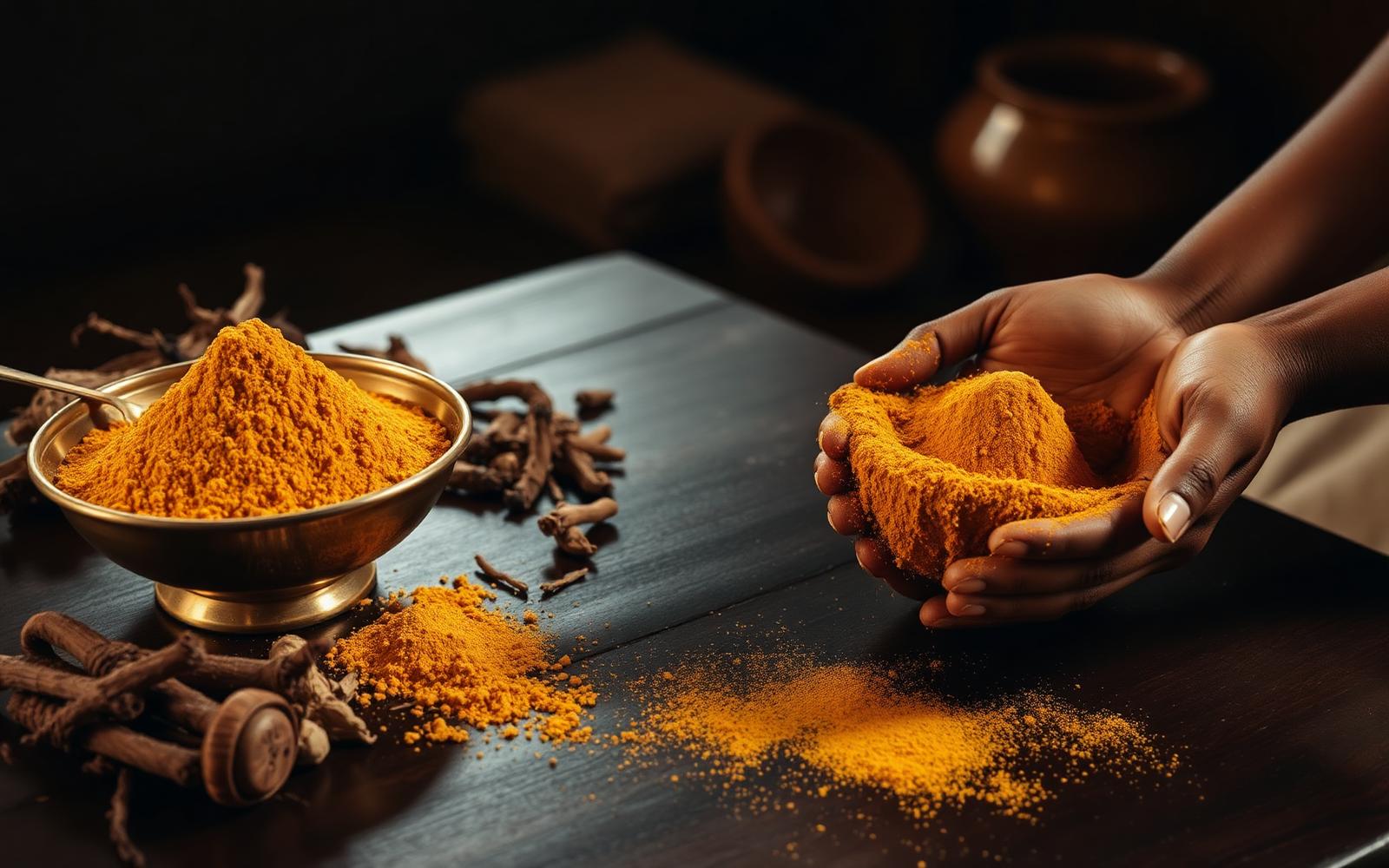
The first thing that surprises people about Udvartanam is the direction. Most massage moves downward, following the limbs away from the heart, coaxing the body towards sleep. Udvartanam moves upward, against the grain of the body hair, with firm friction and a deliberate briskness. It is not designed to make you drowsy. It is designed to wake something up.
The second surprise is the medium. Instead of warm oil there is powder — coarse, dry, herbal, sometimes mixed to a paste, applied with the palms and worked into the skin. By the end of a session the skin is warm and faintly flushed, the body feels lighter in an oddly specific way, and there is a sense of having been scrubbed clean from somewhere deeper than the surface.
Watch this short explanation.
What is Udvartanam?
Udvartanam, sometimes written Udwarthanam or Udvarthana, is a therapeutic massage performed with medicated herbal powders. The word carries the sense of raising or lifting upward, which describes both the physical direction of the strokes and the intended effect on the tissues.
Classical Ayurveda groups it among the daily and seasonal regimens as well as among treatments — it appears in the texts not only as therapy for the unwell but as part of the routine of a person maintaining health. Its stated actions are consistent across sources: it reduces excess Kapha, mobilises accumulated fat tissue, opens the pores and channels, improves the movement of blood and lymph, brings firmness to the skin and lightness to the limbs.
Where Abhyanga, the classical oil massage, nourishes and settles, Udvartanam scrapes and mobilises. They are opposite instruments, and a good treatment plan often uses both — Udvartanam in the earlier phase to loosen and lighten, Abhyanga later to nourish what remains.
Two forms: Snehika and Rukshana
The distinction matters clinically, and it is the first thing a physician decides.
Rukshana Udvartanam — the dry form
Dry herbal powder is used alone, with no oil. This is the more strongly reducing form, chosen where there is heaviness, sluggish metabolism, excess fat tissue, water retention or a coated, dull quality to the skin. It is the form most associated with weight management and with the classical picture of aggravated Kapha.
Snehika Udvartanam — the oil-bound form
The powder is mixed with a suitable medicated oil to form a paste. This softens the friction and adds nourishment, and is chosen where the person is depleted, dry, sensitive-skinned, elderly, or where the aim is skin quality and circulation rather than reduction. Applied to the wrong person, the dry form can leave the skin irritated and the body more depleted than before — which is precisely the judgement the assessment exists to make.
The powders, and why they are chosen
The powders used in Udvartanam are not a single fixed recipe. They are compounded for the person, and the choice of herbs is the therapeutic heart of the treatment.
- ◆Kolakulathadi churna — a classical formulation used widely where heaviness, stiffness and sluggish circulation dominate.
- ◆Triphala churna — used for its cleansing and toning action on the skin and tissues.
- ◆Horse gram and green gram flours — traditional bases that give the mixture its coarse, absorbent quality.
- ◆Aromatic and warming herbs such as vacha, musta, kushta and nagaramothaa — added to increase local warmth and mobilise stagnation.
- ◆Turmeric, sandalwood and other skin-directed herbs — used where complexion, pigmentation or skin texture is part of the picture.
The grind matters as much as the ingredients. Too fine and the powder cannot create the friction the therapy depends on; too coarse and it abrades. Traditional practice is specific about this, and it is one of the small details that distinguishes a properly performed Udvartanam from an approximation.
The procedure, step by step
Assessment first
Before Udvartanam is prescribed, a physician assesses the constitution, the current imbalance, the state of digestion, the strength of the person and the condition of the skin. The same complaint in two people can call for the dry form in one and the oil-bound form in the other. Duration, pressure and the number of consecutive days are set at this point.
The session
- ◆The powder is warmed gently, which makes it more comfortable and increases its action.
- ◆You sit or lie on a wooden treatment table. In many settings two therapists work in synchrony on either side of the body.
- ◆The powder is applied and worked into the skin with firm, upward strokes — always against the direction of the body hair, and always moving towards the heart.
- ◆The pressure is deliberate rather than gentle, and the rhythm brisk. The strokes are adapted over the joints and the abdomen, and over any area the physician has flagged.
- ◆The massage typically continues for thirty to forty-five minutes, until the skin is warm and slightly flushed.
- ◆The powder is then removed, and the session is usually followed by a warm bath or, in a fuller programme, by a medicated steam.
Afterwards
A warm — not hot — bath is standard, often with a herbal powder used in place of soap. Cold water, cold wind and heavy food are avoided for the rest of the day. Warm water, warm and lightly cooked meals, and a period of quiet complete the treatment. Many people notice that they are unusually hungry that evening, and that the hunger is clean rather than craving-driven.
The strokes move upward, towards the heart, always against the hair. This is not a detail of style. It is the therapy.
Benefits of Udvartanam
Ayurvedic weight management
Udvartanam is the therapy most often prescribed where excess weight, heaviness and sluggish metabolism are the concern. Its traditional description is precise: it mobilises accumulated fat tissue, reduces the sense of heaviness in the limbs, and stimulates the metabolic fire.
It deserves saying clearly that Udvartanam is not a weight-loss procedure in the modern sense. No massage removes fat. What it does — and this is well within what the tradition claims — is improve circulation and lymphatic movement in tissue that has become stagnant, reduce fluid retention, and support a programme built on diet, internal medicine, daily routine and movement. Where those elements are absent, the therapy is a pleasant hour with no lasting result. Where they are present, it noticeably accelerates the work.
Circulation and lymphatic movement
The firm upward friction over large areas of the body has an obvious mechanical effect on peripheral circulation and lymph flow. People with cold hands and feet, puffiness that comes and goes, and a general sense of stagnation are frequent candidates.
Skin texture and tone
Because the powder exfoliates while the herbs act on the skin itself, Udvartanam is traditionally used to improve complexion, smooth rough or dull skin and give firmness. This is why some form of it appears in pre-wedding and seasonal regimens throughout Kerala.
Stiffness, heaviness and lethargy
The therapy is often included where the complaint is not pain but heaviness — legs that feel weighted, mornings that take an hour to begin, a body that resists movement. It is also used alongside other therapies in certain joint and muscular conditions where stagnation, rather than dryness, is the dominant factor.
Kapha-dominant conditions
In classical terms, Udvartanam is a Kapha-reducing therapy, and it is used across the range of complaints where Kapha accumulation is central — including certain metabolic patterns, water retention, and some presentations of polycystic ovarian syndrome, always as part of a wider plan.
Who Udvartanam suits, and who should wait
The therapy is generally suited to adults with adequate strength who present with heaviness, excess weight, sluggish digestion, poor peripheral circulation, or dull and congested skin. It suits people who feel better for activity and worse for rest.
It is usually avoided or substantially modified in the presence of open wounds, active skin infection or inflammatory skin disease, significant dryness or emaciation, marked debility or recent illness, fever, pregnancy, immediately after surgery, and where the skin is unusually thin or fragile. In the very depleted, the dry form is generally inappropriate — the oil-bound form, or a different therapy altogether, is chosen instead.
How many sessions, and how they are arranged
Udvartanam is prescribed as a course of consecutive daily sessions. The most common patterns are seven, fourteen or twenty-one days, and it is very often combined with other procedures in the same programme.
- ◆Seven days — a short reset, or as preparation within a larger treatment plan.
- ◆Fourteen days — the usual prescription where weight, metabolic sluggishness or fluid retention is the primary concern.
- ◆Twenty-one to twenty-eight days — for long-standing metabolic patterns, generally alongside internal medicine, dietary correction and supervised routine.
In a residential programme, Udvartanam is often followed by a medicated steam therapy on the same day, and paired over the course of the stay with other procedures — Elakizhi for stiffness, Abhyanga in the concluding phase, and internal preparations throughout.
Udvartanam within Panchakarma
In the staged architecture of Panchakarma, Udvartanam belongs to the preparatory phase, in the category of procedures that dry and lighten before the main therapeutic actions are undertaken. Its function there is specific: to loosen what has accumulated and to open the channels so that the deeper procedures have something to work with.
This is why Udvartanam alone rarely produces the results people hope for, and why it is so effective inside a properly sequenced programme. Our guide to Panchakarma treatment in Kerala explains that sequence in full — what precedes it, what follows, and why the order is not negotiable.
What a session actually feels like
Brisk. Warm. Not painful, but not passive either — most people describe it as invigorating rather than relaxing, and it is common to feel slightly self-conscious about the vigour of it for the first five minutes.
The skin warms early. There is a distinct tingling. Somewhere in the second half of the session the body seems to give up its resistance and the friction begins to feel good rather than intrusive. Afterwards, in the warm bath, the sensation people most often report is lightness — not weight lost, but weight no longer noticed.
By the fourth or fifth day of a course, the changes are less about the session and more about the day around it: better appetite at the right times, less afternoon heaviness, clothes sitting differently, a body that wants to move.
Questions worth asking before you book
- ◆Will a registered Ayurveda physician assess me before the therapy is chosen?
- ◆Which powders will be used, and will the dry or the oil-bound form be used for me — and why?
- ◆Is the powder freshly compounded, and is it prepared for the individual?
- ◆Will diet, routine and internal medicine be part of the plan, or is the massage being offered alone?
- ◆How many consecutive days are recommended, and what follows the course?
If a place cannot answer the second question, it is offering a body scrub. That may be enjoyable, but it is not Udvartanam.
A closing thought
There is a reason this therapy has survived without ever becoming fashionable. It is not luxurious, it does not photograph beautifully, and it asks the body to participate rather than surrender.
But heaviness — the kind that settles quietly over years of sitting, eating late and moving less — responds to friction, warmth and repetition better than to almost anything else. Ayurveda understood this a very long time ago, and simply kept doing it.